
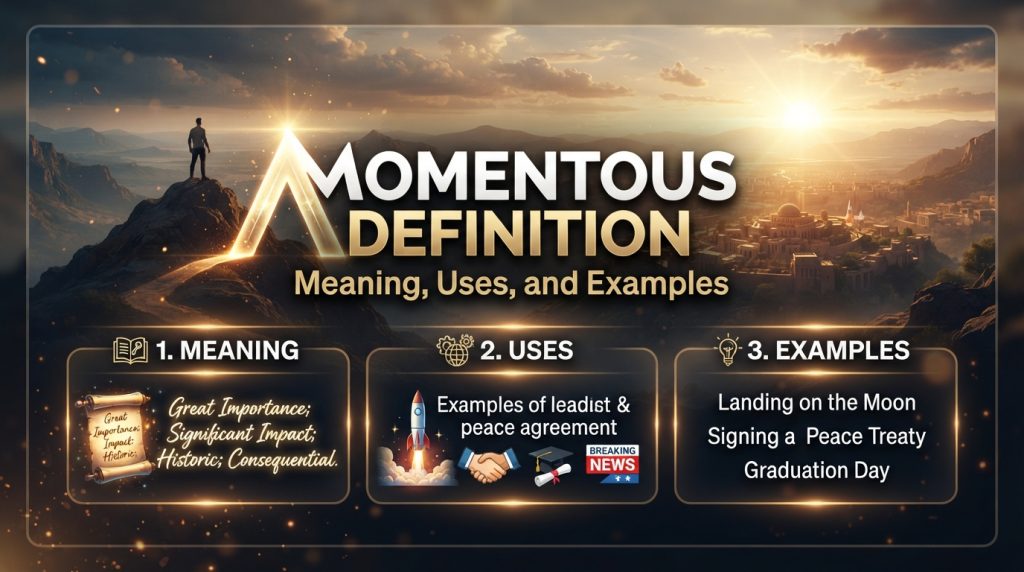
Words carry weight, and few words carry as much as “momentous.” Whether you’re studying for a vocabulary test, writing an essay, or simply curious about the origins and usage of the term, understanding the momentous definition will help you use this powerful adjective correctly and confidently. This article breaks down what the word means, where it comes from, how it’s used in sentences, and how it differs from similar words.
What Does “Momentous” Mean?
At its core, the momentous definition refers to something of great importance, significance, or consequence — typically an event, decision, or occasion that has a lasting impact. When something is described as momentous, it suggests that the moment itself is pivotal, often changing the course of history, a person’s life, or the trajectory of an organization.
Dictionaries generally define “momentous” as an adjective meaning “of great importance or significance, especially in its bearing on the future.” The word is almost always used to describe events, occasions, decisions, or turning points rather than everyday objects or trivial matters. A momentous occasion is one that people remember, reflect on, and often mark with ceremony or commemoration.
The Origin of the Word
To fully appreciate the momentous definition, it helps to look at its etymology. The word “momentous” derives from the Latin term “momentum,” which originally referred to movement or a moving force, and later came to signify a critical point in time — a “moment” that mattered. Over centuries, English speakers adapted “momentous” to describe events or decisions so significant that they seemed to shift the momentum of history itself.
This connection to “momentum” is a helpful memory tool: just as momentum implies force and movement, something momentous implies an event that pushes life, history, or circumstances in a new and important direction.
How “Momentous” Is Used in Sentences
Understanding the momentous definition is only half the battle — knowing how to use the word naturally is equally important. Here are some common contexts where “momentous” appears:
- Historical events: “The signing of the treaty was a momentous occasion that ended decades of conflict.”
- Personal milestones: “Graduating from college was a momentous achievement for her, marking years of hard work.”
- Political decisions: “The Supreme Court’s ruling was momentous, reshaping civil rights law for generations.”
- Scientific breakthroughs: “The discovery of the vaccine was a momentous step forward in public health.”
- Cultural shifts: “The fall of the Berlin Wall was a momentous event that changed the political landscape of Europe.”
In each example, “momentous” signals that the event described isn’t just important in the moment — it has ripple effects that extend into the future.
Momentous vs. Similar Words
One reason people search for the momentous definition is to distinguish it from similar-sounding or similarly-meaning words. Here’s how “momentous” compares to related terms:
- Momentous vs. Important: “Important” is a broader, more general term that can apply to almost anything — a meeting, a document, a person. “Momentous” is reserved for occasions or events with historic or life-changing significance.
- Momentous vs. Significant: “Significant” often implies meaning or relevance, but not necessarily a dramatic turning point. “Momentous” adds a sense of scale and permanence that “significant” doesn’t always carry.
- Momentous vs. Momentary: These two words are frequently confused because they look and sound similar, but they mean almost opposite things. “Momentary” means lasting only a moment — brief and fleeting. “Momentous,” on the other hand, describes something whose impact is anything but brief; it’s an event whose consequences last long after the moment has passed.
- Momentous vs. Historic: “Historic” specifically refers to something that will be remembered in history or that has historical importance. “Momentous” is slightly broader, as it can apply to deeply personal events (like a wedding or the birth of a child) that may never appear in a history book but are still profoundly significant to those involved.
When to Use “Momentous”
Since the momentous definition centers on significance and lasting impact, the word should be reserved for genuinely important situations. Using “momentous” to describe something trivial — like a minor scheduling change or a small purchase — would sound exaggerated or out of place. Instead, save the word for:
- Life-altering personal events (marriages, births, graduations, career changes)
- Major historical or political turning points (elections, treaties, revolutions)
- Groundbreaking scientific or technological achievements
- Organizational milestones (company mergers, product launches that change an industry)
- Emotional or symbolic moments that mark a clear “before and after”
Examples of Momentous Occasions in History
To further illustrate the momentous definition, consider these widely recognized examples:
- The moon landing in 1969, which marked humanity’s first steps on another celestial body.
- The abolition of slavery, a momentous shift in social and legal history.
- The invention of the printing press, which transformed the spread of knowledge worldwide.
- The end of World War II, a momentous turning point that reshaped global politics for decades.
Each of these examples shares a common thread: they didn’t just matter in the moment they occurred — they permanently altered the course of history.
Why Understanding This Word Matters
Learning the momentous definition isn’t just an academic exercise. Using precise vocabulary strengthens your writing and communication, allowing you to convey the true weight of an event rather than relying on vague or overused words like “big” or “important.” Whether you’re writing a speech, a news article, a personal reflection, or an academic paper, choosing “momentous” at the right moment adds gravity and precision to your language.
Conclusion
The momentous definition centers on significance, impact, and lasting consequence. It’s a word reserved for the events, decisions, and milestones that shape our personal lives and the broader world around us. By understanding its meaning, origin, and proper usage — and by distinguishing it from similar words like “momentary” or “significant” — you can use “momentous” with confidence and precision in your own writing and speech. The next time you witness or describe a truly life-changing event, you’ll know exactly the right word to capture its importance.
READ ALSO: https://eliteguestpostsagency.com