
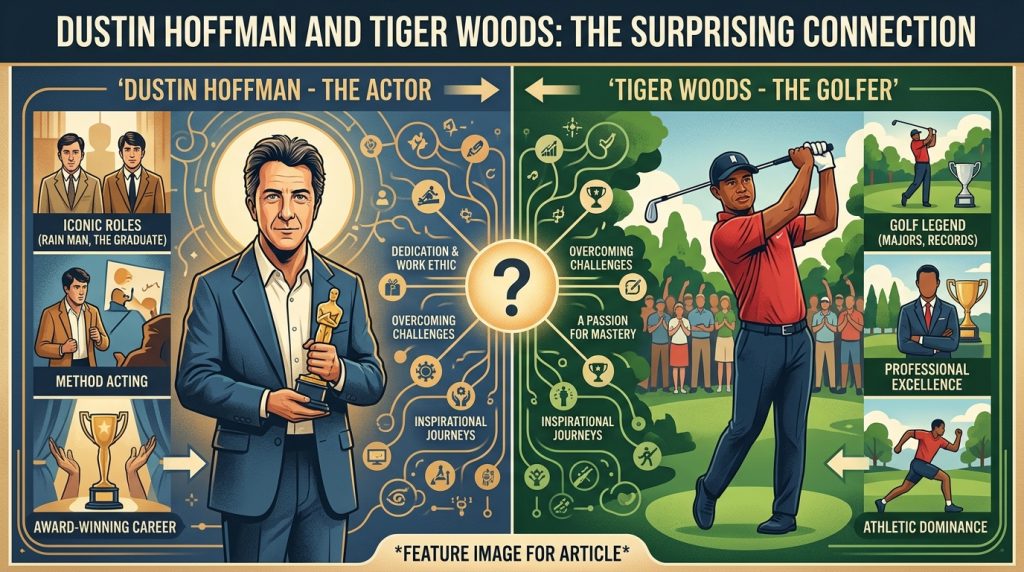
At first glance, one is a Hollywood legend who built a career on disappearing into strange, vulnerable characters. The other is a golfer who built a career on being unbeatable. Yet the phrase dustin hoffman and tiger woods keeps turning up in search bars, trivia nights, and casual debates about greatness. The surprising connection isn’t a secret friendship or a shared film. It’s something more interesting: two very different people who reached the top of their fields in remarkably similar ways.
Why Do People Search for This Pairing?
Part of the answer is simple confusion. Golf has its own Hoffman, tour veteran Charley Hoffman, who has played alongside Woods for decades. When Charley Hoffman qualified for the Genesis Invitational, which is hosted by Woods’ foundation, Woods greeted him in the locker room with a cheeky “good job, old man.” Add golfer Dustin Johnson to the mix, and it’s easy to see how names get scrambled in memory. Someone half-remembering a headline might well type “Dustin Hoffman and Tiger Woods” and wonder what they’re missing.
But the pairing also persists because the two men, however different, are easy to compare. Both are American icons. Both have faced the public’s microscope for decades. And both are defined less by raw talent than by what they did with it.
The Obsession with Craft
Dustin Hoffman rose to fame with The Graduate in 1967, then followed with Midnight Cowboy, Kramer vs. Kramer, Tootsie, and Rain Man. He won two Academy Awards for Best Actor, for Kramer vs. Kramer in 1980 and Rain Man in 1989. What set him apart from many contemporaries was his preparation. For Rain Man, he spent time studying people with autism and savant syndrome, including the real-life Kim Peek, whose extraordinary memory helped inspire the film. For Tootsie, he pushed for months of makeup and wardrobe tests because he wanted the character to be believable, not a gag.
Tiger Woods approached golf with the same intensity. Handed a putter as a toddler, he appeared on national television as a child, won three consecutive U.S. Junior Amateur titles, and then three consecutive U.S. Amateur titles. When he won the 1997 Masters at 21, he did it by twelve strokes, a margin that stunned the sport. Woods didn’t just practice; he engineered his game, rebuilding his swing more than once at the height of his dominance because he believed it could be better.
In both cases, the public sees the performance, but the real story is the thousands of unseen hours behind it. That shared devotion to process is the first thread linking dustin hoffman and tiger woods.
Perfectionism and Its Price
Perfectionism is a gift and a burden. Hoffman has long been described as a demanding collaborator, someone who questions scenes, rewrites lines, and pushes directors and co-stars to keep digging. Colleagues have spoken of friction on some sets, and Hoffman himself has acknowledged that his intensity could be difficult. The same drive that produced masterful work could also strain relationships.
Woods’ story carries a similar tension. His competitiveness produced fourteen major championships by 2008 and a seemingly endless run of victories. But the pressure of that standard, combined with injuries and a very public personal crisis around 2009, brought him low. Neither man’s career was a clean, upward line. Both learned that the qualities that make someone great don’t always make life easy.
The Comeback Factor
Perhaps the strongest parallel is resilience. Woods endured multiple back surgeries, knee operations, and a serious 2021 car accident that threatened his leg. Many assumed his competitive days were over. Then, at the 2019 Masters, he won his fifth green jacket, one of the most celebrated comebacks in sports history. That same year, he received the Presidential Medal of Freedom.
Hoffman’s career has had its own cycles. He experienced enormous peaks, quieter periods, and later returns to critical attention with roles in films like Meet the Fockers, Finding Neverland, and Quartet, and in television. Hollywood is famously unforgiving to aging actors, yet Hoffman kept working across genres, from drama to comedy to voice acting in Kung Fu Panda.
When fans talk about dustin hoffman and tiger woods in the same breath, comeback resilience is often what they mean: the ability to be counted out and return anyway.
Two Stages, One Audience
There’s also a subtler link: both performers depend on an audience that feels ownership over them. Hoffman’s characters, from Benjamin Braddock to Ratso Rizzo to Raymond Babbitt, are woven into popular memory. Woods’ moments, the chip-in at Augusta, the 2008 U.S. Open on a damaged knee, are replayed the way film scenes are. Each man delivers moments people quote, rewatch, and argue about.
Both also transformed their fields. Hoffman helped define a generation of naturalistic, character-driven American acting, a counterpoint to the polished leading men that came before. Woods changed golf’s athleticism, popularity, and prize money, inspiring a generation of players to train like athletes. Many of today’s tour stars say they took up the game because of him.
What the Connection Really Teaches Us
It’s tempting to look for a dramatic hidden story linking two famous names. Often the real insight is quieter. Dustin Hoffman and Tiger Woods show that greatness in very different arenas tends to share a recognizable shape:
- Early commitment. Both devoted themselves to their crafts long before fame arrived.
- Relentless refinement. Neither was satisfied with “good enough.”
- Costly intensity. The drive that elevated them also created struggles.
- Endurance. Each found ways to return after setbacks.
None of this requires the two to have ever shared a stage, a set, or a fairway. The connection is about patterns, and those patterns apply far beyond Hollywood and golf. Anyone pursuing mastery, whether in music, medicine, business, or sport, can recognize the same ingredients.
Final Thoughts
The next time you see the names Hoffman and Woods together, you may be looking at a mix-up with another golfer, or at a curious mind noticing a deeper similarity. Either way, the pairing invites a worthwhile question: what does it actually take to be the best at something, and what does it cost?
If there’s a single answer, it’s the one these two careers keep giving. Talent opens the door, but preparation, persistence, and the willingness to begin again are what keep a person in the room.
READ ALSO: https://eliteguestpostsagency.com