
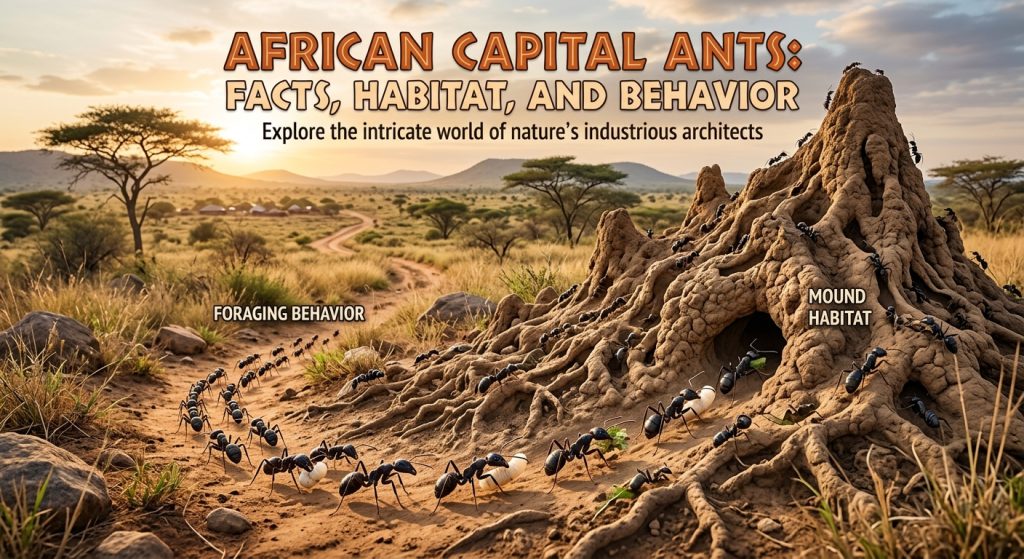
Ants are among the most successful animals on Earth, and Africa has some of the most fascinating species. One group that draws attention from hobbyists and curious readers is known informally as african capital ants. The name is not a formal scientific classification, and you will mostly see it in ant-keeping circles and online discussions. It is generally used for big-headed ants of the genus Pheidole, found across the African continent, whose oversized heads (from the Latin caput, meaning “head”) give the name its logic. Because the label is informal, it can refer to different species depending on who is using it. This article covers what is known about these ants: their traits, where they live, and how they behave.
What Are African Capital Ants?
African capital ants belong to the large family Formicidae and the subfamily Myrmicinae. The genus Pheidole is one of the most diverse ant genera in the world, with over a thousand described species. Many are native to Africa, and some have spread far beyond it. The best-known example is Pheidole megacephala, the African big-headed ant, which is now an invasive pest in many tropical and subtropical regions.
What sets these ants apart is a division of labor reflected in body shape. Colonies have two distinct worker types:
- Minor workers are small and slender. They forage, tend brood, and handle most daily tasks.
- Major workers, often called soldiers, have enormous heads packed with powerful jaw muscles. They defend the colony, crush hard seeds, and cut up large prey.
This two-caste system, called worker polymorphism, is the defining feature of the group. The size gap between minors and majors can be striking, with a soldier’s head sometimes nearly as wide as its entire body is long.
Physical Characteristics
Most big-headed ants are small to medium in size. Minor workers typically measure two to three millimeters, while majors are somewhat larger. Colors range from light yellow-brown to reddish-brown or dark brown, depending on species. They have a two-segmented waist (the petiole and postpetiole), a hallmark of the Myrmicinae, and a stinger that is often weak or reduced compared to related ants.
The queen is larger than the workers and is the colony’s sole egg-layer in many species. Some colonies, particularly those of invasive big-headed ants, can contain multiple queens, which allows them to grow into enormous supercolonies.
Habitat and Distribution
The habitat range of african capital ants is wide, which is part of why they have been so successful. They are found in savannas, grasslands, woodlands, agricultural land, and increasingly in urban areas. Different species prefer different conditions, but most share a few common preferences:
- Warm climates. These ants thrive in tropical and subtropical temperatures and are most active when conditions are warm and humid.
- Soil nesting. Most colonies build underground nests, often beneath stones, logs, or debris. Entrances are typically small, marked by a modest mound of excavated soil.
- Disturbed ground. Big-headed ants do well in places altered by humans, such as gardens, farms, and the edges of buildings. Disturbance often reduces competition from native ants, which gives them room to expand.
Within Africa, they occur from the southern tip of the continent up through the tropical belt. Beyond Africa, introduced populations have been established in Australia, the Pacific islands, the Americas, and parts of Europe, often arriving through shipping and the movement of plants and soil.
Diet and Foraging
These ants are omnivores and opportunists. Their diet usually includes:
- Small insects and other arthropods, including termites
- Seeds, which the major workers can crack open
- Sugary liquids such as honeydew produced by aphids and mealybugs
- Dead animals and food scraps
Foraging is organized and efficient. Minor workers lay chemical trails, called pheromone trails, that guide nestmates to food. Once a good source is found, recruitment can be rapid, and a steady column of workers may form within minutes. Major workers often join when the food is large or hard to process, using their strong mandibles to break it down.
Their relationship with honeydew-producing insects is worth noting. By tending aphids and scale insects, these ants gain a reliable sugar source and may protect those insects from predators. This can harm crops and garden plants, which is one reason big-headed ants are considered agricultural pests in some regions.
Social Behavior and Colony Life
Colony life among african capital ants is highly structured. The queen or queens lay eggs, minors care for the brood and forage, and majors defend the nest and process tough food. Communication relies mainly on chemical signals, with different pheromones marking trails, signaling alarm, and identifying nestmates.
Aggression and Competition
Big-headed ants are known for aggressive behavior toward other ants. When a threat is detected, soldiers move out quickly to confront intruders, often supported by swarms of minor workers. In invasive populations, this aggression allows them to displace native ant species and disrupt local ecosystems. In some areas, they have been shown to reduce the numbers of other insects and even affect the animals that depend on them.
Reproduction and Colony Growth
New colonies form in two main ways. In some species, winged males and queens leave the nest on a mating flight, after which a mated queen founds a new colony alone. In others, especially invasive populations, colonies spread by “budding”: a group of workers, brood, and one or more queens simply walk away from the parent nest and set up a new one nearby. Budding is a major reason why these ants can expand so quickly and form interconnected supercolonies with many nests.
Ecological Role
In their native African ranges, big-headed ants play a meaningful part in the ecosystem. They help control populations of small invertebrates, turn over and aerate soil as they dig, and contribute to seed handling and nutrient cycling. Native populations tend to coexist with other ant species in balanced communities.
The picture changes where they are introduced. Without the natural checks of their home range, they can become dominant, outcompeting native ants and altering food webs. This dual identity, valuable in one place and problematic in another, is a good example of how a species’ impact depends on context.
Interaction with Humans
Most people encounter these ants as household or garden nuisances. They can invade kitchens in search of food, and their tendency to protect sap-feeding insects can worsen pest problems on plants. Their stings are mild, and they are not considered dangerous to people. Common control methods include sealing entry points, removing food sources, and using baits that workers carry back to the nest. Baits are generally more effective than sprays, since they reach the queens and brood.
Conclusion
African capital ants are a compact lesson in how specialization and social organization can make a small animal enormously successful. Their big-headed soldiers, efficient foraging, flexible nesting habits, and ability to expand by budding explain why they thrive across so many habitats. Whether you see them as fascinating insects to study or as pests to manage, they are worth understanding. Because the name is informal, anyone wanting to identify a specific species should consult a regional ant guide or an entomologist, who can confirm which big-headed ant is actually in front of you.
READ ALS0: https://eliteguestpostsagency.com