
Millions of Texans rely on the Supplemental Nutrition Assistance Program (SNAP) to put food on the table, and the numbers behind it change every year. If you are trying to work out whether your household qualifies, the first thing to know is that the limits reset each October. This guide explains SNAP eligibility Texas households need to understand for 2026, including the current income limits, deductions, work rules, and how to apply.
Which Limits Apply Right Now?
The federal government updates SNAP figures for each fiscal year, which runs from October 1 to September 30. Limits for the 2026 fiscal year applied from October 2025 through September 2026. New limits took effect on October 1, 2026, and stay in place through September 2027. If you are applying today, the newer figures are the ones that matter. If you applied earlier in the year, you were measured against the previous ones.
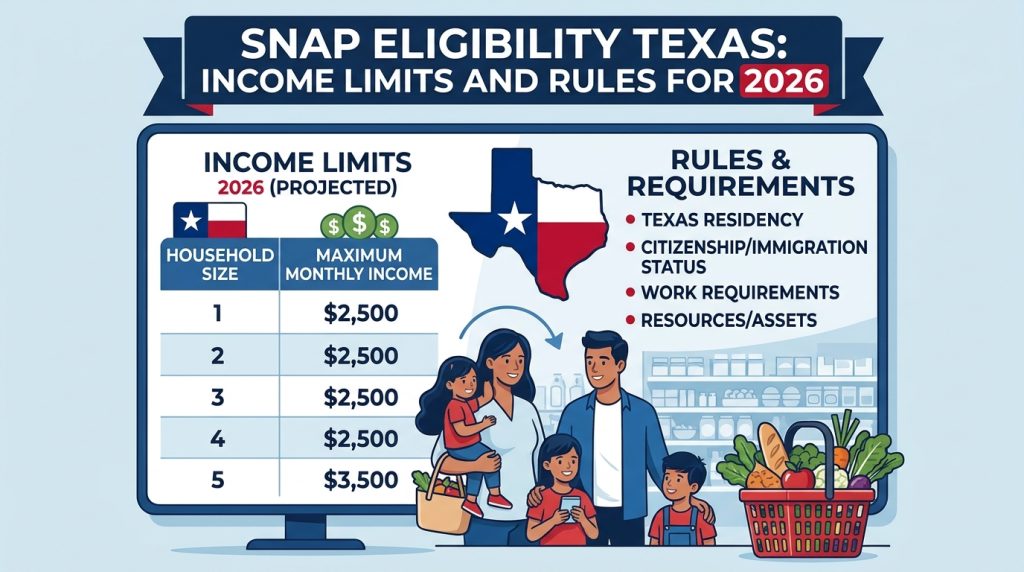
Texas Income Limits by Household Size
Texas runs SNAP through the Texas Health and Human Services Commission (HHSC) and applies two income tests. Your household’s gross income is everything you earn before taxes and deductions. Your net income is what remains after allowable deductions are subtracted.
Federal rules set the standard gross limit at 130% of the federal poverty level. Texas uses Broad-Based Categorical Eligibility, which lets many households qualify under a higher gross limit of 165%. HHSC’s handbook lists these limits for household sizes one through ten, including the 165% column, effective October 1, 2026. Here are the monthly figures for the most common household sizes:
| Household size | Gross limit (130%) | Gross limit (165%) | Net limit (100%) |
|---|---|---|---|
| 1 | $1,729 | $2,195 | $1,330 |
| 2 | $2,345 | $2,976 | $1,804 |
| 3 | $2,960 | $3,757 | $2,277 |
| 4 | $3,575 | $4,538 | $2,750 |
| 5 | $4,191 | $5,319 | $3,224 |
| 6 | $4,806 | $6,100 | $3,697 |
For each additional person beyond ten, the handbook adds $616 to the 130% gross limit, $474 to the net limit, and $781 to the 165% limit.
The year-over-year change is modest. A single person’s 165% limit was roughly $2,152 under the earlier fiscal year’s figures, compared with $2,195 now. If your income sits close to the line, it is worth rechecking even if you were turned down before.
How the Gross and Net Tests Work
Most households must pass both tests. Your gross income is checked first, and then HHSC subtracts deductions to calculate your net income. The limits are tied to the federal poverty guidelines, so they rise with them and can make more households eligible without changing benefit formulas.
Households with a member who is 60 or older, or who has a disability, are treated differently. Under federal regulation, such a household only needs to meet the net income limit and is not held to the gross test. If you fall into this group, don’t rule yourself out based on your gross pay alone.
Deductions That Lower Your Countable Income
Deductions are often what bring a household under the net limit. If anyone in your household works, HHSC automatically subtracts 20% of their gross wages. Other common deductions include:
- A standard deduction that varies by household size
- Dependent care costs needed for work, training, or school
- Medical expenses over a set threshold for elderly or disabled members
- Court-ordered child support payments
- Shelter costs, including rent, mortgage, utilities, and homeowners insurance, once they exceed a portion of your income
Keep rent receipts, utility bills, and childcare invoices handy. Deductions only help if HHSC knows about them.
Resource and Asset Rules
Texas also looks at countable resources such as cash and bank balances. The most commonly cited Texas resource limit is $5,000 for most households. Your home and, in most cases, your primary vehicle are not counted. Because resource rules have exceptions, particularly for elderly and disabled households, confirm your situation with HHSC rather than relying on a general figure.
Non-Financial Requirements
Income is only part of SNAP eligibility Texas applicants must satisfy. You also need to:
- Live in Texas. You apply in the state where you reside.
- Provide identity and a Social Security number for each household member applying for benefits.
- Meet citizenship or immigration requirements. Federal law restricts SNAP to U.S. citizens and certain lawfully present noncitizens, and recent federal legislation narrowed which noncitizen groups qualify. Mixed-status families can still apply for eligible members, such as U.S.-citizen children.
- Follow work rules, if they apply to you. Adults between 18 and 60 generally need to work or report at least 80 hours a month, or they may be limited to three months of benefits in a three-year period. Recent federal changes expanded the age range and narrowed some exemptions for these work requirements, so older adults and some parents who were previously exempt should check their status carefully.
Exemptions exist for people who are disabled, pregnant, caring for a young child or incapacitated person, or already meeting other qualifying work or program requirements.
How Much Could You Receive?
Meeting the limits does not guarantee a large benefit. Your monthly amount is based on the maximum allotment for your household size minus about 30% of your net income. For fiscal year 2027, the maximum is $306 for one person, $562 for two, and $1,023 for a family of four. Households with little or no net income receive amounts close to the maximum, while those near the net limit may receive only a small benefit.
How to Apply
You can apply online through YourTexasBenefits.com, in person at an HHSC benefits office, by mail, or by fax. Be ready to provide:
- Photo ID for the head of household
- Proof of income, such as recent pay stubs or an employer statement
- Proof of expenses, such as a lease, utility bills, and childcare costs
- Social Security numbers and immigration documents for applicants
After you apply, HHSC schedules an interview, usually by phone. Respond promptly. Missed interviews and missing paperwork are among the most common reasons applications are delayed or denied. Standard processing can take up to 30 days.
Expedited Benefits for Emergencies
If your household is in a crisis, you may qualify for faster help. One path to expedited SNAP is having $100 or less in liquid resources while your countable gross monthly income is under $150. Other emergency situations can also qualify, so say so when you apply. Local food banks can help bridge the gap while you wait.
Common Mistakes to Avoid
- Assuming you earn too much. Deductions and the 165% gross limit mean many working families qualify.
- Using outdated numbers. Limits changed on October 1, 2026, and old charts online may still show last year’s figures.
- Skipping the interview. Missing it can close your case.
- Forgetting to report changes. Changes in income, household size, or address may need to be reported during your certification period.
The Bottom Line
SNAP eligibility Texas residents face in 2026 comes down to household size, income after deductions, and a handful of resource, residency, and work rules. With the October 2026 update, a single person can earn up to $2,195 a month in gross income under the expanded limit, and a family of four up to $4,538. Eligibility also depends on deductions, work requirements, and your household’s circumstances, so use these figures as a guide rather than a final answer. For a definitive decision, check the current figures on the HHSC website or apply through YourTexasBenefits.com. If you are close to the line, applying is the only sure way to find out, and it costs nothing.
READ ALSO: https://eliteguestpostsagency.com